


Overview
Updated September 2026 by Allen Recruitment Group’s European Recruitment Specialists
This guide is for practical HR and recruitment planning and is not a substitute for French legal, tax or immigration advice.
France remains one of Europe’s most attractive destinations for international employers seeking highly skilled talent. As the second-largest economy in the European Union, France offers access to a highly educated workforce, world-class infrastructure, and thriving technology, engineering, life sciences, manufacturing, renewable energy and financial services sectors.
This guide provides employers with up-to-date information on recruitment, employment law, salaries, employee benefits, work permits, labour costs and hiring trends in France in 2026.
Hiring in France involves more than finding the right candidate. Employers must navigate French employment law, collective agreements, social-security administration, immigration requirements, data protection, non-discrimination rules and increasingly important European requirements around pay transparency and artificial intelligence.
2026 at a glance: France remains a substantial recruitment market, but employers should build compliance into the recruitment process from the beginning. The CNIL’s 2026 priorities specifically include recruitment, with attention to automated decision-making, candidate information and data-retention periods. France’s pay-transparency transposition bill was presented to the Council of Ministers on 10 September 2026 but remains subject to parliamentary examination.

Recruitment in France
Job Market Overview
France remains the second-largest economy in the European Union and continues to attract multinational employers seeking access to highly skilled talent due to its strong economy, highly qualified talent pool and strategic position within the European Union.
Several structural trends are shaping recruitment in France during 2026:
- Increased demand for AI, cybersecurity, cloud, software engineering and data professionals.
- Continued skills shortages in healthcare, engineering, life sciences and advanced manufacturing.
- Growing adoption of hybrid and remote working models.
- Greater focus on salary transparency and pay equity.
- Increased use of international recruitment and mobility programmes to address skills shortages.
- Expansion of startup and scale-up hiring supported by the French Tech ecosystem.
France continues to offer:
- Strong employee protections.
- Extensive social security coverage.
- Access to the wider EU talent market.
- A highly qualified multilingual workforce.
- Competitive incentives for innovation and R&D investment.
France has a large and diversified employment market spanning technology, engineering, finance, life sciences, manufacturing, professional services, healthcare, retail and other sectors. Recruitment conditions vary substantially by occupation and region, so employers should validate the availability of the specific skill set rather than rely on national unemployment figures alone.
France Travail’s 2026 Besoins en Main-d’Œuvre survey records approximately 2.28 million planned recruitment projects nationally, with 43.8% judged difficult to fill. The proportion varies significantly by sector and region. For example, the survey reports recruitment difficulty of 51.1% for equipment, electrical/electronic, IT and machinery activities and 45.9% for scientific, technical, administrative and support services.
Recruitment channels
- France Travail – national public employment service.
- APEC – particularly relevant to professional and managerial recruitment.
- LinkedIn and specialist professional networks – useful for specialist and passive talent.
- French job boards – use the channel appropriate to the occupation and seniority.
- Recruitment agencies – particularly useful for scarce skills, confidential searches, international hiring and time-critical appointments.
- Employee referrals and professional networks – useful where trust and specialist networks materially affect candidate attraction
Skills Shortages
Talent shortages remain particularly acute in:
- Software Development
- AI & Machine Learning
- Cybersecurity
- Cloud Engineering
- Electrical Engineering
- Healthcare
- Biotech
- Pharmaceutical Research
- Green Energy
These shortages continue to drive international recruitment activity.
The French labour market remains highly regulated. Employers must comply with:
- French Labour Code requirements.
- Collective bargaining agreements (Conventions Collectives).
- Social security regulations.
- Anti-discrimination legislation.
- Data privacy requirements under GDPR and CNIL guidance.
- Employee consultation obligations where applicable
Job Benefits: Mandatory & Common Optional Benefits
Employment terms in France are influenced by legislation, the employment contract and the applicable convention collective. Employers should identify the applicable collective agreement before finalising the offer because it can affect classification, minimum pay, working time, notice, benefits and other employment conditions.
Mandatory Employee Benefits
French employers must provide:
Social Security Coverage
Includes:
- Healthcare
- Pension Contributions
- Unemployment Insurance
- Family Benefits
- Workplace Accident Insurance
Paid Annual Leave
Employees accrue:
- 30 working days
- Equivalent to 5 weeks paid leave annually
Public Holidays
France observes 11 national public holidays, although entitlement varies according to collective agreements and region.
Sick Leave
Employees may receive statutory compensation subject to eligibility rules.
Maternity Leave
Minimum entitlement typically starts at:
- 16 weeks for first child
with longer periods for multiple births and larger families.
Paternity and Childcare Leave
France continues to promote parental leave and family-friendly employment practices.
Mandatory Health Insurance
Employers must provide supplementary health insurance (“Mutuelle”) and contribute at least 50% of the premium cost.
Common Additional Benefits
Employers frequently offer:
- Meal vouchers (Tickets Restaurant)
- Additional pension schemes
- Bonus programmes
- Transportation subsidies
- Wellness programmes
- Home office allowances
- Private health top-ups
- Learning and development budgets
- Additional annual leave
Minimum Wage in France 2026
National Minimum Wage (SMIC)
As of June 2026, the French minimum wage (SMIC) increased to:
- €12.31 per hour
- €1,867.02 gross per month based on a 35-hour working week.
Employers must also verify whether their applicable collective bargaining agreement establishes a higher minimum salary.
Social Security Ceiling (PASS)
For 2026:
- Annual PASS: €48,060
- Monthly PASS: €4,005
These figures influence:
- Pension calculations
- Social contribution thresholds
- Certain employment cost calculations
Remote Working in France Hybrid and Remote Work
Remote work in France should be assessed against the employer’s applicable collective agreement, charter, policy and individual arrangements. Employers should also consider working-time controls, workload, health and safety, information security, equipment and the employee’s right to privacy.The statutory reference for full-time work is 35 hours per week, although collective agreements and working-time arrangements can provide for different arrangements.
For international employers, do not assume that an employee can simply work permanently from France because the company employs them elsewhere. Cross-border tax, social-security, immigration and permanent-establishment considerations may arise.
Remote work is now firmly established across the French labour market.
Employers should maintain a formal remote work policy covering:
- Eligibility criteria
- Equipment provision
- Working hours
- Performance management
- Health and safety
- Cybersecurity
- Data protection
Employees generally maintain the same rights as onsite colleagues, including training, benefits and career progression opportunities.
Employers must also respect France’s “Right to Disconnect” principles and avoid excessive out-of-hours communications.
Employment Contracts in France
Permanent Contracts (CDI)
The Contrat à Durée Indéterminée (CDI) remains the default form of employment in France.
CDIs provide:
- No predetermined end date
- Strong employee protections
- Access to statutory benefits
- Greater employee retention
Dismissals require a lawful “real and serious” reason together with compliance with statutory procedures.
Fixed-Term Contracts (CDD)
CDD contracts may only be used in specific circumstances such as:
- Temporary workload increases
- Seasonal work
- Replacing absent employees
- Project-specific assignments
Improper use may result in reclassification to a CDI by French labour courts.
Probation Periods
Typical maximum probation periods are:
| Employee Category | Maximum Initial Duration |
| Workers & Employees | 2 months |
| Technicians & Supervisors | 3 months |
| Executives | 4 months |
Extensions may only occur where specifically permitted by collective agreements and employment contracts.
Hiring Foreign Employees in France
EU / EEA Citizens Citizens of EU and EEA countries may generally work in France without requiring work authorisation.
Non-EU Employees Employers hiring non-EU nationals must verify:
- Residence status
- Work authorization
- Visa eligibility
- Right-to-work documentation
Popular routes include:
- Talent Passport
- French Tech Visa
- EU Blue Card
- Intra-Company Transfer permits
Recent updates have increased scrutiny of work permit applications and employer documentation requirements.
Employment Hubs in France
Where are the main employment hubs?
Paris and the wider Île-de-France region remain a major employment centre, while Lyon, Toulouse, Bordeaux, Marseille, Nantes, Lille, Rennes, Grenoble, Strasbourg and other metropolitan areas have important specialist talent pools. In 2026, France Travail reports 388,810 planned recruitment projects in Île-de-France, with material differences in recruitment difficulty between regions.
For specialist recruitment, map the talent pool by occupation rather than treating France as a single labour market.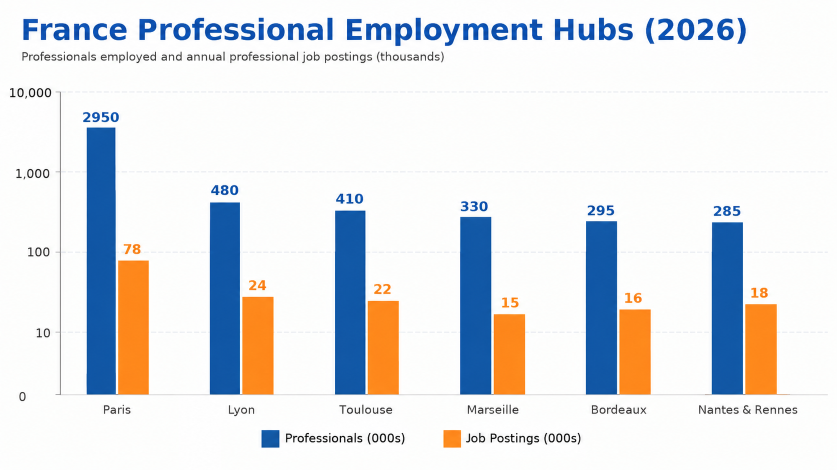
Paris France’s largest professional talent market and home to major international employers.
Key sectors:
- Financial Services
- Technology
- Consulting
- AI
- Life Sciences
Lyon
Strong hub for:
- Biotechnology
- Pharmaceuticals
- Manufacturing
- Shared Services
Toulouse
Known globally for:
- Aerospace
- Engineering
- Advanced Manufacturing
Bordeaux
Growing centre for:
- Technology
- Renewable Energy
- Digital Services
Nantes & Rennes
Fast-growing markets for:
- Software Engineering
- Telecommunications
- Green Technologies
While some rural regions in France may have fewer job opportunities, the government has implemented initiatives to promote regional development and job creation. These initiatives contribute to regional development and aim to ensure a more balanced distribution of job opportunities throughout the country:
- Regional Investment Funds (FIR): Financing and support provided to small and medium-sized enterprises (SMEs) in various regions to stimulate economic growth and create jobs.
- Regional Innovation Agencies (ARI): Supporting innovation and entrepreneurship in regional areas through funding and resources for startups and SMEs.
- French Tech: Promoting the technology sector and assisting digital startups in regions across France to drive economic growth and employment.
- Regional Development Agencies (ARD): Supporting economic development and job creation in different regions by offering funding, training, and resources to businesses and entrepreneurs.
- Regional Strategic Plans (PSR): Setting out a strategic vision for economic development and job creation in specific regions, focusing on sectors like renewable energy, digital technology, and tourism.
Recruitment Landscape
Recruitment channels
- France Travail – national public employment service.
- APEC – particularly relevant to professional and managerial recruitment.
- LinkedIn and specialist professional networks – useful for specialist and passive talent.
- French job boards – use the channel appropriate to the occupation and seniority.
- Recruitment agencies – particularly useful for scarce skills, confidential searches, international hiring and time-critical appointments.
- Employee referrals and professional networks – useful where trust and specialist networks materially affect candidate attraction
Skills Shortages
Talent shortages remain particularly acute in:
- Software Development
- AI & Machine Learning
- Cybersecurity
- Cloud Engineering
- Electrical Engineering
- Healthcare
- Biotech
- Pharmaceutical Research
- Green Energy
These shortages continue to drive international recruitment activity.
The French labour market remains highly regulated. Employers must comply with:
- French Labour Code requirements.
- Collective bargaining agreements (Conventions Collectives).
- Social security regulations.
- Anti-discrimination legislation.
- Data privacy requirements under GDPR and CNIL guidance.
- Employee consultation obligations where applicable
French Labour Market Overview
France continues to maintain one of the largest labour markets in Europe, with approximately 30.4 million people in employment at the end of 2024. The employment rate for people aged 15-64 reached 69.3% in 2025, its highest level in over 50 years, while labour force participation rose to 75.1%.
Key labour market indicators:
- 30.4 million people employed across France.
- 69.3% employment rate for the 15-64 age group in 2025.
- 7.7% unemployment rate in 2025, remaining below historic highs despite a slight increase from recent lows.
- Labour force participation reached 75.1%, the highest level since 1975.
Gender Representation
Women account for approximately 49% of salaried employment in France. While overall workforce participation is relatively balanced, significant sectoral differences remain. Women are strongly represented in public services and healthcare but remain underrepresented in construction and industrial occupations.
Employee Tenure
Employee mobility remains high, particularly among younger professionals. LinkedIn and labour market data indicate that average tenure in France remains relatively short by European standards, especially in technology, digital, and professional services sectors, where job changes every 1-3 years are increasingly common.
Key Industry Sectors
France has a predominantly service-based economy:
- Services: 78.3% of employment
- Industry: 19.3% of employment
- Agriculture: 2.3% of employment
Major employment sectors include:
- Wholesale and retail trade
- Manufacturing
- Professional and business services
- Healthcare and social services
- Construction
- Information technology and digital services
Main Job Boards and Candidate Sourcing Channels (2026)
The most widely used recruitment channels in France include:
- France Travail (formerly Pôle emploi) – www.francetravail.fr
- Indeed France – www.indeed.fr
- APEC – www.apec.fr (executive and professional recruitment)
- Cadremploi – www.cadremploi.fr
- HelloWork (formerly RegionsJob) – www.hellowork.com
- Talent.com – fr.talent.com
- Jooble – fr.jooble.org
- Meteojob – www.meteojob.com
- JobTeaser – www.jobteaser.com (graduates and early careers)
French recruitment is highly structured while France’s recruitment landscape is competitive and diverse, making use of multiple recruitment channels methods for attracting and hiring candidates. Recruitment agencies are widely used as they are effective in matching candidates with job openings, especially for high-level and specialized positions. Besides agencies, online job boards and social networks are also popular avenues through which job seekers actively pursue employment opportunities.
Recruitment agencies in France typically operate on success fees or retained contracts, which typically range from 15% to 30% of a candidate’s annual salary.
How do I hire an employee in France?
Recommended recruitment workflow
- Define the role: job title, responsibilities, location, working pattern, reporting line and essential qualifications.
- Identify the applicable collective agreement: confirm the convention collective and classification implications.
- Set objective selection criteria: distinguish essential requirements from desirable criteria.
- Set the compensation framework: establish the budget and document the rationale for the proposed salary.
- Recruit and assess: use structured interviews and evidence-based assessment.
- Complete right-to-work checks: establish whether the candidate requires work authorisation.
- Make the offer: confirm contract type, salary, benefits, working time, location and applicable collective provisions.
- Complete pre-employment administration: including the DPAE where applicable.
- Onboard: arrange required occupational-health processes and provide required employment information.
CDI – permanent employment
The contrat à durée indéterminée (CDI) is the normal form of employment in France. Alternative contract types should only be used where their legal conditions are satisfied.
CDD – fixed-term employment
A contrat à durée déterminée (CDD) is subject to specific legal rules governing when it may be used, its duration, renewal and termination. Employers should confirm the precise legal basis and applicable collective-agreement provisions before using a CDD.
Temporary / agency employment
Temporary employment (travail intérimaire) is subject to a separate statutory framework, including rules on permitted grounds and maximum mission durations. For example, the maximum duration for many common temporary assignments is 18 months, but the applicable maximum depends on the reason for the assignment.
Pre-employment administration
The Déclaration préalable à l’embauche (DPAE) is required for employees and must be submitted to URSSAF before the employee starts work or begins the probationary period, and no earlier than 8 days before the employment start date.
GDPR, Candidate Data & CV Retention in France
Candidate CVs, application forms, interview notes, assessment results, communications and other candidate information are personal data. Recruitment processing must comply with the GDPR and French data-protection rules.
2026 CNIL retention position
The most important update for employers is the CNIL’s 2026 HR retention framework. Do not use a blanket rule such as “delete every CV after two years”. Different purposes have different retention periods.
| Recruitment data / purpose | 2026 CNIL position | Practical action |
| Candidate selected for the role | Active recruitment processing until the recruitment outcome; successful candidate data then moves into personnel administration as appropriate. | Close the recruitment record and transfer only the data required for employment administration. |
| Unsuccessful candidate – evidential purpose | 5 years from the date the position was filled for potential discrimination claims; the CNIL framework identifies this as an obligation based on Article L.1134-5 of the French Labour Code. | Keep the relevant evidence in a controlled, restricted archive rather than an unrestricted active talent pool. |
| Candidate talent pool / CV database | Up to 2 years from the last contact for candidates whose profile interests the employer, subject to the conditions identified by the CNIL framework, including opposition/consent considerations. | Record the last-contact date, provide the required information, apply access controls and automate deletion/review at the deadline. |
These periods are not interchangeable. The 5-year evidential period and the 2-year talent-pool period serve different purposes. The CNIL’s April/May 2026 framework expressly distinguishes mandatory retention from CNIL-recommended periods and requires purpose-based retention. citeturn6view2turn1search3
Candidate information and privacy notice
Tell candidates what personal data is being collected, why it is being processed, the relevant legal basis, who receives it, how long it will be retained and what rights the candidate has. Recruitment information should be concise and accessible.
Interview notes: what should hiring managers record?
Interview notes should be factual, job-related and evidence-based. They should allow another reviewer to understand why a candidate did or did not meet the stated selection criteria.
- Record evidence, not personality judgments.
- Link comments to a competency, qualification or role requirement.
- Avoid comments about age, family circumstances, health, religion, ethnicity, nationality, political views, trade-union activity, sexual orientation or other protected/personal matters.
- Do not write speculative statements such as “probably won’t stay” or “not the right type of person”.
- Do not keep informal candidate notes in personal notebooks, private email accounts or messaging applications.
- Use the ATS or approved recruitment system and apply appropriate access controls.
CNIL’s recruitment guidance confirms that recruitment operations involving candidate data – including collection, consultation, retention, communication and deletion – are processing activities under GDPR. citeturn3search2
2026 compliance focus
The CNIL has identified recruitment as a priority control area in 2026, specifically highlighting automated decision-making, candidate information and retention periods. Large companies and recruitment agencies are among the organisations prioritised for these checks. citeturn2search6
Non-Discrimination and Candidate Assessment
Recruitment decisions must not be based on prohibited discriminatory criteria. French rules protect candidates against discrimination on numerous grounds, including origin, sex, family situation, pregnancy, physical appearance, health, disability, age, political opinions, trade-union activity, religion, nationality, ethnicity, sexual orientation and gender identity. citeturn1search1
Questions an interviewer should ask
Questions should have a direct and necessary connection with the job or the candidate’s professional capabilities. For example, a driving-licence question is appropriate where driving is genuinely required for the role. Questions about family circumstances or health are generally not appropriate recruitment questions. citeturn1search0
Recommended candidate scorecard
| Assessment area | What to record |
| Essential technical capability | Specific evidence demonstrating the required skill. |
| Relevant experience | Comparable responsibilities, scale and outcomes. |
| Problem solving | Evidence from structured questions or work samples. |
| Communication | Evidence relevant to the role, not personal style preferences. |
| Leadership / collaboration | Examples of behaviours and outcomes. |
| Motivation | Candidate’s stated reasons for the role and organisation. |
| Overall assessment | Clear decision against the pre-defined criteria. |
Salary Transparency & Pay Setting – 2026 Update
The EU Pay Transparency Directive requires Member States to transpose new pay-transparency rules. France missed the 7 June 2026 transposition deadline; however, a French transposition bill was presented to the Council of Ministers on 10 September 2026 and remains subject to parliamentary examination. citeturn6view1
What employers should prepare for
The French government’s September 2026 summary of the bill states that, under the proposed framework, employers would have to inform applicants of the proposed remuneration or a salary range during recruitment and would no longer be able to request information about current or previous remuneration. citeturn6view1
Important: these proposed French-law requirements should not be presented as already fully effective French law while the bill remains under parliamentary examination. Employers should nevertheless prepare their job architecture, salary bands and recruiter scripts now.
- Define salary ranges before advertising roles.
- Use objective, gender-neutral criteria for pay decisions.
- Stop relying on a candidate’s previous salary as the basis for an offer.
- Train recruiters and hiring managers on salary discussions.
- Review job titles and adverts for gender-neutral language.
- Ensure the applicable collective agreement and classification are understood before an offer is made.
AI and Automated Recruitment in France – 2026
AI is increasingly used for CV matching, candidate sourcing, screening, assessment, interview transcription and ranking. In France, employers must consider GDPR requirements and French non-discrimination principles when using these tools.
What hiring teams should do now
- Maintain a documented inventory of AI tools used in recruitment.
- Know whether the supplier is making recommendations, rankings or decisions.
- Do not treat an algorithmic score as a substitute for human review.
- Test systems for discriminatory outcomes and document the controls applied.
- Tell candidates about relevant processing and automated decision-making where required.
- Control vendor access to CVs, interview recordings and assessment data.
- Define retention periods for AI-generated profiles, scores, transcripts and recordings.
- Ensure the organisation can explain and challenge significant recruitment decisions.
The EU AI Act’s employment-related high-risk rules are subject to a revised implementation timetable, with the European Commission’s current guidance indicating application of the relevant high-risk rules for employment systems from 2 December 2027. Separately, AI Act transparency obligations under Article 50 began applying from 2 August 2026. Employers should therefore distinguish between obligations already applicable, GDPR requirements that already apply, and future high-risk employment-system requirements.

Visas and Permits
Visas & Work Permits
EU/EEA and Swiss nationals generally do not require a French work permit solely because they are being employed in France. For non-EU nationals, employers must establish the candidate’s right to work and follow the applicable immigration route.
Work-authorisation check
Where a work authorisation is required, it should be addressed before the employee starts work. For a foreign national who holds a residence document authorising employment, the employer generally has a duty to verify the authenticity of the document with the relevant authority at least two working days before the start date, subject to the statutory exceptions.
Talent residence permits
France has several “talent” residence routes for eligible non-EU professionals. The precise route and remuneration/qualification criteria depend on the category and current rules. Employers should verify the current requirements at the point of recruitment rather than rely on historic thresholds.
Employment tax & costs in France
The cost of employing someone in France cannot safely be reduced to a single percentage added to gross salary. Employer costs depend on salary level, employee status, contribution ceilings, exemptions or reductions, benefits, collective-agreement provisions and the precise employment arrangement.
For budgeting purposes, employers should model:
- Gross base salary.
- Variable compensation and bonuses.
- Employer social-security and pension contributions.
- Supplementary health and other benefits.
- Paid-leave and working-time arrangements.
- Recruitment and onboarding costs.
- Immigration and relocation costs where applicable.
- Potential agency or EOR fees.
The statutory minimum wage (SMIC) remains a legal floor for adult employees, subject to the applicable rules and any more favourable collective-agreement minimum.
How much does it cost to employ someone in France?
On average, employers contribute approximately 40% to 45% of the employee’s gross salary, although the actual cost varies depending on salary level, company size, industry, location, and eligibility for contribution reductions. Employers are responsible for calculating, deducting and remitting both employer and employee social security contributions through the French payroll system.
In France, both employers and employees contribute to the social security system, with specific employer contributions determined by factors such as business type, size, remuneration level and applicable contribution relief schemes. [urssaf.fr], [cleiss.fr]
Social Security Ceilings (PASS)
- Annual value: €48,060 in 2026.
- Monthly value: €4,005.
- Daily value: €220.
- Hourly value: €30.
Employer Payroll Contributions
- Health, Maternity, Disability, Death (rate varies based on income): 13.00% or 7.00%.
- Autonomy Solidarity Contribution (CSA): 0.30%.
- Old Age Insurance (ceiling of €4,005 per month / €48,060 annually): 8.55%.
- Old Age Insurance (uncapped): 2.11%.
- Family Benefits (rate varies based on income): 3.45% to 5.25%.
- Unemployment (ceiling of €16,020 per month): 4.00%.
- AGS (Wage Guarantee Insurance): 0.25%.
- Supplementary Pension & CEG (depends on income level): 6.01% to 15.57%.
- Total Employment Cost: approximately 32% to 55% of gross salary (additional employer contributions such as FNAL, apprenticeship tax, professional training, mobility levy and occupational accident insurance may also apply).
Employee Payroll Contributions
- Old Age Insurance (ceiling of €4,005 taxable income per month): 6.90%.
- Old Age Insurance (uncapped): 0.40%.
- General Social Contribution (CSG): 9.20%.
- Social Debt Repayment Contribution (CRDS): 0.50%.
- Supplementary Pension & CEG (depends on income): approximately 4.01% to 9.72%.
- Total Employee Cost: typically 22% to 28% of gross salary before income tax withholding.
Income Tax Brackets (2026 rates applicable to 2025 income)
- 0.00%: Up to €11,600.
- 11.00%: €11,601 to €29,579.
- 30.00%: €29,580 to €84,577.
- 41.00%: €84,578 to €181,917.
- 45.00%: More than €181,917.
Disclaimer: French payroll taxation is complex and contribution rates may vary depending on the employee’s status (cadre/non-cadre), salary level, company size, industry sector, location, occupational risk classification and eligibility for social contribution reductions. Employers should obtain professional payroll advice for specific cases.

French Employment Laws
Working time
The statutory full-time reference is 35 hours per week, 151.67 hours per month or 1,607 hours per year, although collective agreements and working-time arrangements can modify how working time is organised.
Probationary periods
For CDI employees, the maximum initial probationary period depends on employee category: generally 2 months for workers/employees, 3 months for technicians/supervisors and 4 months for cadres. Renewal is not automatic and requires the applicable legal/collective/contractual conditions to be satisfied. Service-Public’s 2026 guidance confirms, for example, that a cadre’s initial probationary period can be up to 4 months and can reach 8 months after a valid renewal.
Occupational health
A newly hired employee generally receives a visite d’information et de prévention (VIP) within 3 months of starting work, subject to statutory exceptions and different rules for certain roles.
Collective agreements
Always establish the applicable convention collective. It can materially affect salary minima, classification, working time, probation, notice, benefits and other employment conditions.
CSE – employee representation
A Comité social et économique (CSE) is required in businesses reaching the statutory employee threshold of 11 employees, with different rights and obligations depending on headcount. HR processes should therefore take account of CSE requirements where relevant.
Notice Period in France
The notice period (préavis) is the amount of time that an employer or employee must generally give before terminating an employment contract. Immediate termination without notice may apply in cases of gross misconduct (faute grave) or wilful misconduct (faute lourde).
For employees on an open-ended contract (CDI) who are dismissed:
- Less than 6 months’ service: as determined by the applicable collective bargaining agreement (CBA) or local practice.
- 6 months to less than 2 years’ service: 1 month’s notice.
- 2 years or more of service: 2 months’ notice.
Many CBAs provide a 3-month notice period for managerial employees (cadres).
For resignations, notice periods are usually determined by the employment contract or applicable CBA and commonly range from 1 to 3 months.
For fixed-term contracts (CDD), the contract normally ends on the agreed date unless terminated early under specific legal circumstances.
Maternity & Paternity Leave in France
French law provides employees with statutory maternity, paternity and parental leave rights.
Maternity Leave (congé maternité)
- 16 weeks for a first or second child.
- 26 weeks from the third child onwards.
- 34 weeks for twins and 46 weeks for triplets or more.
- At least 8 weeks of leave are mandatory, including a minimum of 6 weeks after childbirth.
- Social Security maternity benefits are payable subject to eligibility requirements.
Parental Leave (congé parental d’éducation)
- Available to employees with at least one year’s service.
- May be taken full-time or part-time.
- Can generally continue until the child reaches 3 years of age.
- Usually unpaid by the employer.
Paternity Leave (congé de paternité et d’accueil de l’enfant)
- 25 calendar days for the birth of one child.
- 32 calendar days for multiple births.
- Plus 3 working days of birth leave (congé de naissance).
- Generally taken within 6 months of birth.
- Social Security benefits may apply.
Family Caregiver Leave (congé de proche aidant)
- Available to care for a dependent relative or household member.
- Up to 3 months per period.
- Renewable up to a total of 1 year throughout the employee’s career.
- Generally unpaid by the employer.
Sick Leave in France
Sick leave (arrêt maladie) allows employees to take time off work due to illness or injury while receiving income support from the French Social Security system.
Key points:
- A medical certificate (certificat médical) is required.
- Social Security sickness benefits (IJSS) generally begin after a 3-day waiting period.
- Benefits are usually calculated at approximately 50% of the employee’s reference salary, subject to statutory caps.
- Employees with at least one year’s service are generally entitled to an employer salary top-up, unless more favourable CBA provisions apply.
- Employer top-ups may increase compensation to around 90% of normal salary for an initial period.
- There is no fixed statutory maximum duration for ordinary sick leave.
- Employers may request medical updates and an expected return-to-work date.
Redundancy Payment in France
Employees on an open-ended contract (CDI) with at least 8 months’ continuous service are generally entitled to statutory severance pay (indemnité légale de licenciement) when dismissed for economic or personal reasons.
Severance pay is not payable in cases of gross misconduct (faute grave) or wilful misconduct (faute lourde).
The statutory minimum severance payment is:
- 25% (1/4) of one month’s reference salary for each year of service up to 10 years.
- 33.33% (1/3) of one month’s reference salary for each year of service beyond 10 years.
The reference salary is the more favourable of:
- The average gross monthly salary during the 12 months preceding termination; or
- One-third of the gross remuneration received during the 3 months preceding termination, including a proportional share of bonuses.
Many collective bargaining agreements provide more generous severance entitlements than the statutory minimum.
In addition to severance pay, employees may also be entitled to:
- Payment in lieu of notice (indemnité compensatrice de préavis).
- Compensation for accrued but unused annual leave (indemnité compensatrice de congés payés).
Standard recruitment fees (retention)
Recruitment-agency fees in France are commercial terms rather than a statutory tariff. The fee structure should be agreed according to the assignment, seniority, scarcity, exclusivity, replacement terms, search methodology and service level.
When an agency business case makes sense
- The role is scarce or technically specialised.
- The internal team lacks access to the relevant French talent pool.
- The role is confidential or sensitive.
- The vacancy is business-critical and delay has measurable cost.
- Direct sourcing has not produced a viable shortlist.
- The business is entering France and lacks local recruitment knowledge and employer brand.
- Cross-border hiring or immigration expertise is required.
Challenges when recruiting in the French market
The French recruitment process is particularly susceptible to certain obstacles and factors, such as increased competition for talent and complex labour laws, that must be navigated to ensure recruitment success.
Here are some key challenges employers may encounter when recruiting:
- Strict labour laws: France has comprehensive labour laws that cover various aspects of employment, making compliance complex and time-consuming for employers unfamiliar with the French legal framework.
- Language barrier: Despite English being widely spoken in multinational companies and major cities, language can still be a barrier during recruitment as many candidates prefer to communicate in French.
- Regulatory complexity: French employment law and collective agreements require local knowledge.
- Talent scarcity: France Travail’s 2026 data shows 43.8% of planned recruitment projects nationally were considered difficult.
- Compensation expectations: employers need a defensible salary framework and should prepare for the incoming pay-transparency regime.
- Immigration: non-EU recruitment can add lead time and documentation requirements.
- GDPR: candidate information, interview notes, AI outputs and CVs require controlled processing and retention.
- AI governance: recruitment technology must be assessed for privacy, transparency and discrimination risks.
In dealing with these aspects, working with legal advisors and recruitment experts familiar with the French market is extremely beneficial. Plus, investing in employer branding, networking, and maintaining a positive employer reputation are as well all important steps in attracting and retaining top talent.

Benefits of using Recruitment Agencies v Employer of Record Services
An Employer of Record (EOR) is an organisation that acts as an employer for legal and tax purposes. The EOR is legally responsible for paying international employees, as well as handling employee taxes, insurance, and benefits. The business where the employee works retains control over business operations.
A recruitment agency can also provide similar services but is usually responsible for hiring directly for the jobs and employees themselves, as well as managing contracts between employer and employee.
A recruitment agency and an Employer of Record (EOR) solve different problems.
| Need | Recruitment agency | EOR |
| Find and attract candidates | Yes | Usually not the primary service |
| Permanent direct employment by your French entity | Candidate search/selection support | Usually not required if you already employ directly |
| Payroll and employment administration | Not the core recruitment service | Core function |
| Specialist market mapping | Core recruitment capability | Usually secondary |
Choose the model based on the business problem. Recruitment support and employment infrastructure are not interchangeable services.
Choosing Allen Recruitment
Allen Recruitment supports international and local employers with specialist recruitment across France and wider European markets. Our approach combines local market knowledge with technology-led sourcing and structured candidate engagement.
- Senior led, single account manager across all locations
- Specialist permanent recruitment.
- International and cross-border candidate sourcing.
- Technology, finance, sales & marketing, HR, Multi-lingual and business-support recruitment.
- Market mapping and passive-candidate identification.
- Senior and confidential appointments.
- Volume-Based Fee Structure / tiered pricing approach recognising the efficiencies gained through multiple concurrent placements while delivering greater value and cost savings.
For employers unfamiliar with the French market, our role is to provide practical recruitment-market insight while helping the hiring process remain structured, candidate-focused and compliant.
Are you interested in learning more about employing fantastic talent in France, but you’re not sure where to start? Or perhaps you simply need a little help to get on your way? Then please don’t hesitate to reach out to us at [email protected]
Local Terminology Reference Guide:
| TERMS | IRELAND | THE UK | POLAND | THE NETHERLANDS | FRANCE | SPAIN | SWEDEN |
|---|---|---|---|---|---|---|---|
| TEMPORARY EMPLOYMENT | Temporary / PAYE | Temporary / PAYE | Praca tymczasowa | Tijdelijke tewerkstelling | Travail intérimaire ou temporaire | Trabajo Temporal | Tidsbegränsad anställning |
| TEMPORARY CONTRACT | Temporary contract | Temporary contract | Umowa o pracę tymczasowa | Tijdelijk contract | CDD – Contrat à durée déterminée | Contrato Temporal | Tidsbegränsad kontrakt |
| INCOME TAX | USC – Universal Social Charge | Income Tax / Tax | PIT | Inkomstenbelasting | Impôt sur le revenu | IRPF – Impuesto sobre la Renta de las Personas Físicas | Inkomstskatt (paid to SKV) |
| SOCIAL SECURITY CONTRIBUTIONS | PRSI | NI – National Insurance | ZUS | Werknemersverzekeringen | URSSAF – Union de Recouvrement des cotisations de Sécurité Sociale et d’Allocations Familiales |
TGSS – Tesorería General de la Seguridad Social | Socialförsäkringsavgift (paid to SKV) |
| VAT | VAT | VAT | VAT | BTW – Belasting Toegevoegde Waarde | TVA | IVA – Impuesto sobre el Valor Añadido | Moms – Mervärdesskatt |
| SICK LEAVE | Sick Leave | Sick Leave | L4 – Zwolnienie Lekarskie | Ziekteverlof | Arrêt maladie | La baja por enfermedad | Sjukskriven (medical certificate) / Sjukfrånvaro (absence due to illness) |
Frequently Asked Questions: Hiring in France in 2026
How long can an employer keep an unsuccessful candidate’s CV in France?
There is no single universal “CV retention period” for every purpose. The CNIL’s 2026 HR retention framework identifies 5 years from the date the position was filled for certain evidential purposes relating to potential discrimination claims, while a candidate talent pool may generally retain relevant data for up to 2 years from the last contact, subject to the conditions set out by the CNIL. These purposes and storage arrangements should be kept separate.
Can an employer ask a candidate about their current salary in France?
France’s September 2026 pay-transparency bill proposes that employers will not be able to request information about a candidate’s current or previous remuneration. However, the bill was still before Parliament on 21 September 2026, so employers should distinguish the proposed future rule from the law currently in force.
Does France require salary ranges in job adverts in 2026?
The EU Pay Transparency Directive provides for applicant information about initial pay or a pay range. France’s transposition was still in legislative process in September 2026. Employers should prepare to disclose ranges, but the exact effective French-law requirements and implementation timetable should be checked before relying on the future regime as if it were already fully enacted.
What questions should a French interviewer avoid?
Questions should relate directly and necessarily to the role and professional capabilities. Questions concerning matters such as health, family circumstances, religion, political opinions, trade-union activity or other protected characteristics should not be used as selection criteria.
Is a DPAE required when hiring in France?
Yes. The DPAE must be submitted to URSSAF before the employee starts work or begins the probationary period, no earlier than 8 days before the start date.
What is the normal employment contract in France?
The CDI is the normal form of employment. CDD and temporary employment arrangements are available where their statutory conditions are met.
What is the statutory working week in France?
The statutory reference for full-time employment is 35 hours per week, although collective agreements and other lawful working-time arrangements can alter how working time is organised.
Do non-EU candidates need a French work permit?
Potentially yes. The requirement depends on the candidate’s nationality, residence status and employment route. Employers should verify the candidate’s right to work before the employee starts and follow the applicable immigration procedure.
Official 2026 Sources & Further Reading
- CNIL – Le guide du recrutement
- CNIL – 2026 HR data-retention framework
- Service Public Entreprendre – French pay-transparency transposition bill, 10 September 2026
- EUR-Lex – EU Pay Transparency Directive 2023/970
- France Travail – BMO 2026 recruitment data
- Service Public – probationary periods
- URSSAF – DPAE
- Service Public – foreign-worker work authorisation
Posted in: Blog / France


