


A data-led analysis of 57,000 professionals working within the US venture-backed cybersecurity and information security ecosystem
Updated: October 2026
This report analyses approximately 57,000 US-based profiles identified through a search of professionals working for privately held, VC-backed organisations at Pre-seed, Seed, Series A, Series B and Series C, using Information Security and Cybersecurity company tags. The original search also excludes categories including Staffing and Recruiting, BPO, Outsourcing and Recruitment.
An important limitation should be noted. Some employer, job-title and classification data includes healthcare and staffing-related entries despite those exclusions. For that reason, this report describes the population as the defined VC-backed cybersecurity and information-security search pool, rather than assuming that every individual profile represents a cybersecurity specialist.
Overview
This report analyses approximately 57,000 US-based profiles identified through a search of professionals working for privately held, VC-backed organisations at Pre-seed, Seed, Series A, Series B and Series C, using Information Security and Cybersecurity company tags. The original search also excludes categories including Staffing and Recruiting, BPO, Outsourcing and Recruitment.
An important limitation should be noted. Some employer, job-title and classification data includes healthcare and staffing-related entries despite those exclusions. For that reason, this report describes the population as the defined VC-backed cybersecurity and information-security search pool, rather than assuming that every individual profile represents a cybersecurity specialist.
Key Findings at a Glance
- 57,000+ profiles within the defined US VC-backed cybersecurity and information-security company search pool.
- 14.7 years average professional experience, with a median of 13 years.
- 3.8 years average tenure, with a median tenure of 2.9 years.
- New York leads the location data with 3.7K profiles, narrowly ahead of San Francisco at 3.4K, with Austin third at 2.4K.
- Engineering is the largest functional group, accounting for 22% of profiles.
- Computer Software and Computer & Network Security are the two largest industries shown, representing 35% and 23% respectively.
- The gender data records 54% male, 32% female and 14% unknown, making the unknown category important when interpreting representation.
Talent Hubs
The strongest concentrations of talent are not confined to a single US technology corridor. The location data points to several substantial recruiting markets across the East Coast, West Coast, Texas and other regional technology centres
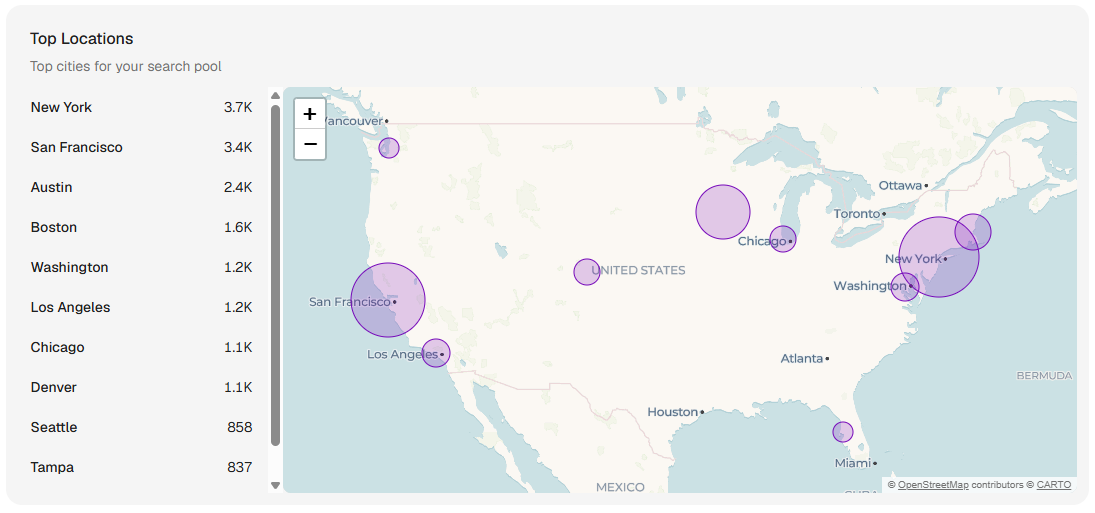
New York is the largest individual talent hub in the dataset with 3.7K profiles, only slightly ahead of San Francisco at 3.4K. Austin is a substantial third market at 2.4K, while Boston, Washington, Los Angeles, Chicago and Denver each offer pools exceeding 1,000 profiles.
For employers, the important point is the breadth of potential hiring locations. A search focused exclusively on San Francisco would leave significant pools of relevant talent elsewhere in the United States.
Experience & Tenure
The experience data is one of the report’s strongest findings. The population represented here is not predominantly early-career startup talent. It contains professionals with substantial workplace experience, alongside evidence of a relatively mobile employment market.
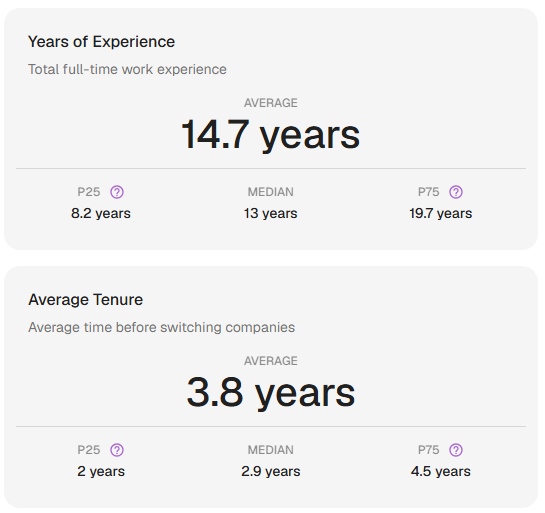
Professionals in the search pool average 14.7 years of full-time experience, with a median of 13 years. The upper quartile reaches 19.7 years, demonstrating considerable depth of experience within the market.
For companies scaling security products or teams, this suggests access to a meaningful population of people whose careers extend well beyond their current VC-backed employer
Average tenure is 3.8 years, while the median is 2.9 years. The lower quartile is two years and the upper quartile 4.5 years, illustrating considerable variation in how long professionals remain with individual employers.
These figures provide useful context when considering candidate mobility. Employers should not assume that experienced technology professionals necessarily remain with the same organisation for long periods.
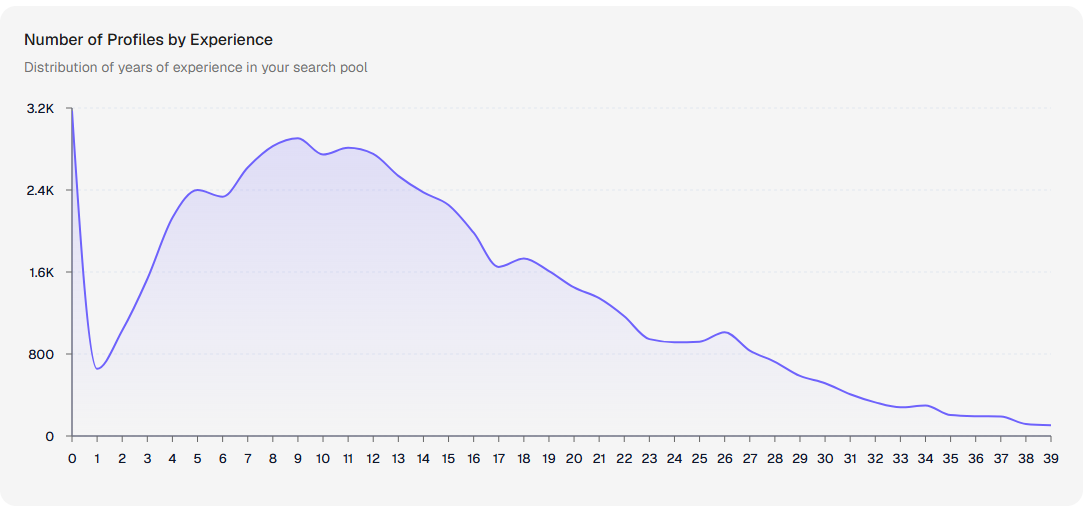
The experience distribution reinforces the averages: this is a broad talent population rather than one dominated by a single career stage. The depth across the experience curve gives employers scope to recruit at different levels rather than treating the VC-backed market solely as a source of younger startup talent.
Employers
Examining current and previous employers helps identify both where this population works today and the organisations that have contributed to its earlier career experience. The latter is particularly useful when considering adjacent sources of talent.
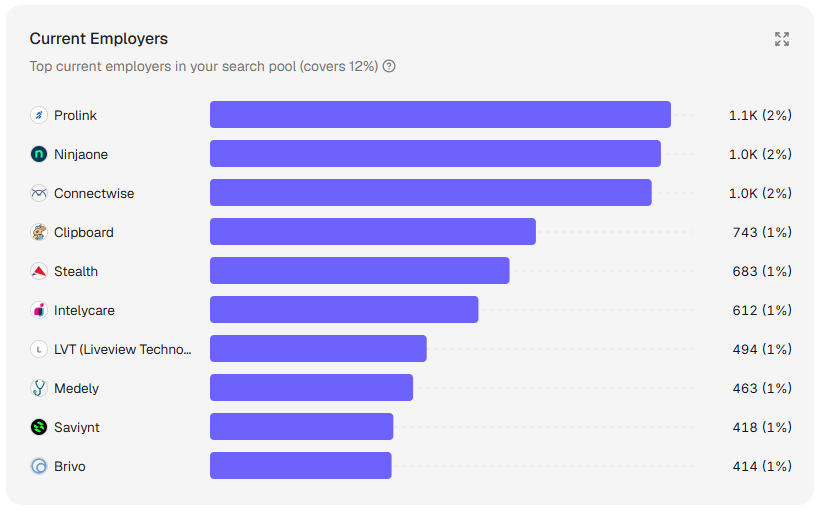
The leading current employers shown include Brivo, Saviynt, LVT, ConnectWise and NinjaOne, alongside several healthcare-related organisations. Importantly, the top employers collectively cover only 12% of the total search pool, indicating that the workforce is spread across a much broader employer base rather than concentrated within a small number of businesses.
That fragmentation matters to recruiters: accessing this market requires broader mapping than simply targeting employees from a handful of well-known cybersecurity companies.
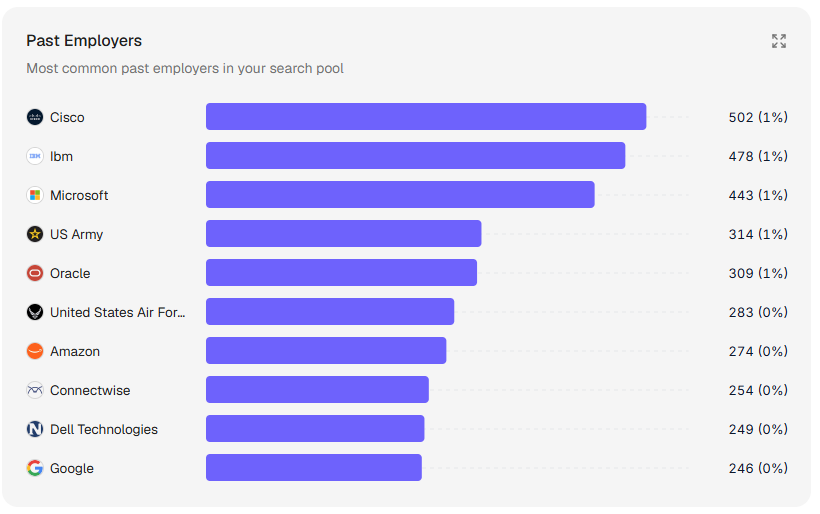
Cisco, IBM and Microsoft are the most represented previous employers shown, alongside the US Army, Oracle, US Air Force, Amazon, ConnectWise, Dell Technologies and Google.
This is an interesting hiring signal. Relevant experience within VC-backed environments does not necessarily originate in other startups. Large technology businesses and technically focused public-sector organisations also form part of the previous-employer landscape represented in this talent pool1.
Leadership & Functions
The data gives us three useful perspectives: the specific roles people hold, their level of seniority and the functions they perform across VC-backed businesses.
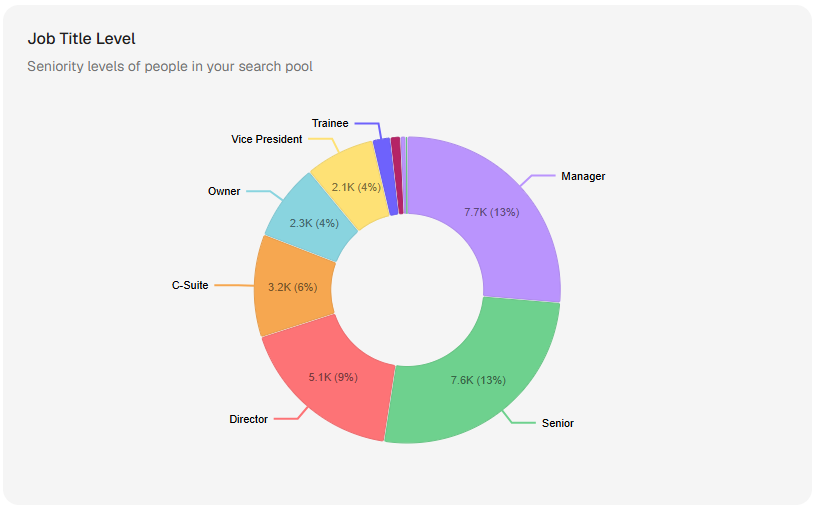
The dataset contains sizeable populations at management and senior levels: 7.7K profiles are classified as Manager and 7.6K as Senior, with a further 5.1K at Director level, 3.2K C-Suite, 2.3K Owner and 2.1K Vice President.
This breadth gives companies recruiting into scale-up environments potential access to talent ranging from experienced individual specialists through to managers and senior leaders.
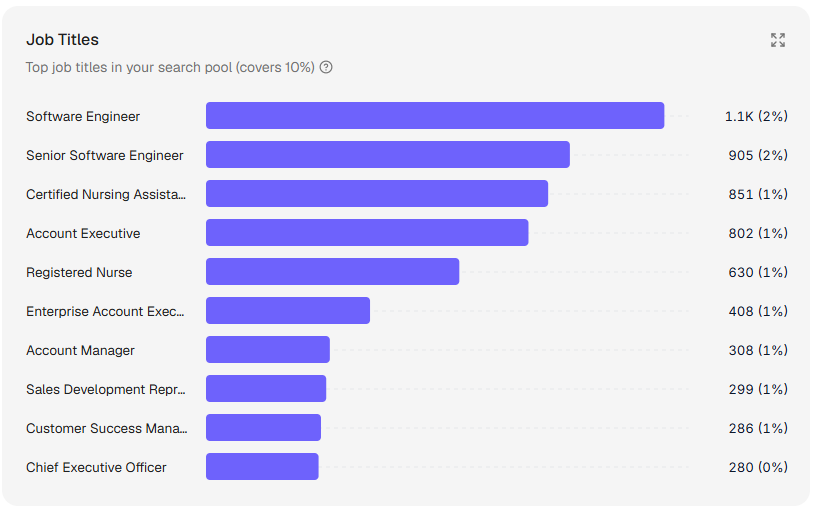
The most common titles show a broad mix of technical, commercial and operational roles. Software Engineer and Senior Software Engineer feature prominently, alongside Account Executive and Enterprise Account Executive, demonstrating the importance of both product development and revenue generation within the population.
The chart also includes titles such as Certified Nursing Assistant and Registered Nurse. Given the cybersecurity focus of the search, these should be interpreted cautiously and reinforce the importance of viewing the dataset as a defined company-search pool rather than assuming every profile is a cybersecurity specialist.
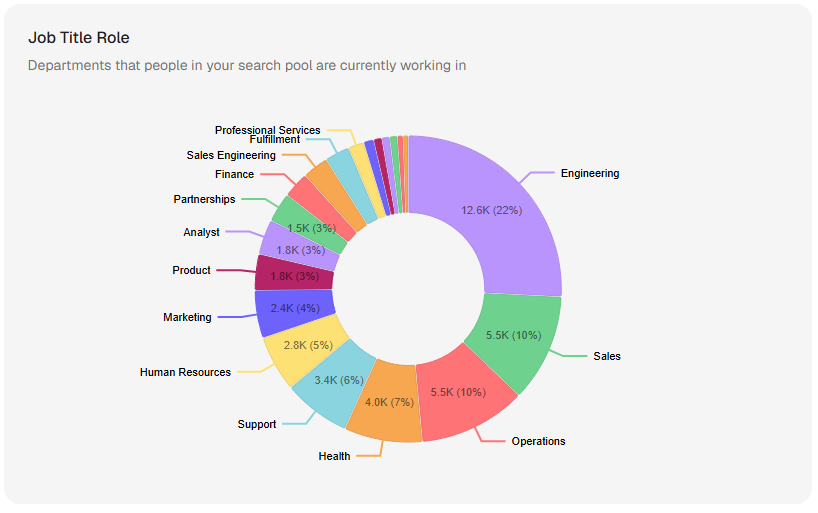
Software Engineering is the largest functional talent pool at 22%, representing approximately 12.6K profiles. Sales and Operations each account for around 10%, with Support, Human Resources, Marketing, Product and other functions also represented.
The mix illustrates that the workforce surrounding venture-backed security businesses extends well beyond technical specialists. Scaling these businesses also requires substantial commercial, operational and customer-facing capability
Company Landscape
The company data provides context on the environments in which this workforce currently operates, including industry classification, funding stage and technology-related company tags.
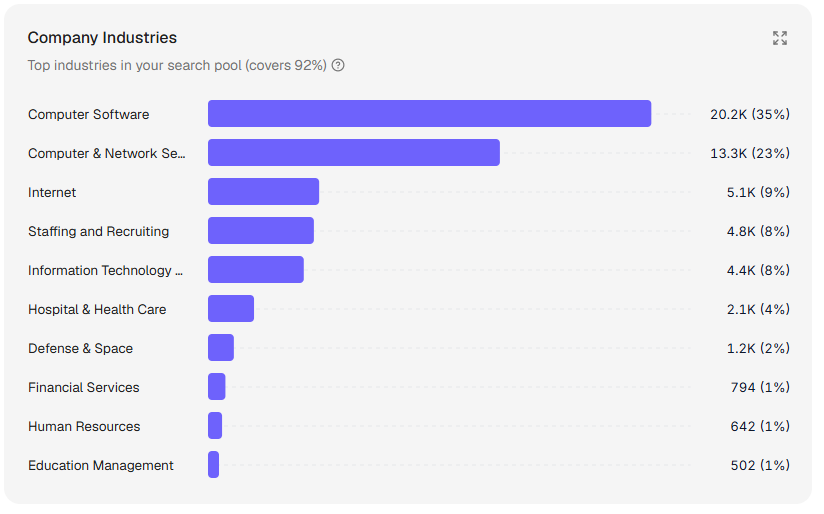
Computer Software is the largest industry classification at 35%, followed by Computer & Network Security at 23%. Internet represents 9% and Information Technology-related organisations 8%.
The figures underline the strong relationship between cybersecurity recruitment and the broader software and technology ecosystem. However, the presence of Staffing and Recruiting at 8%, despite recruitment-related exclusions in the search criteria, is also a reminder that database classifications and company tags can overlap and should not be treated as perfectly clean industry boundaries.
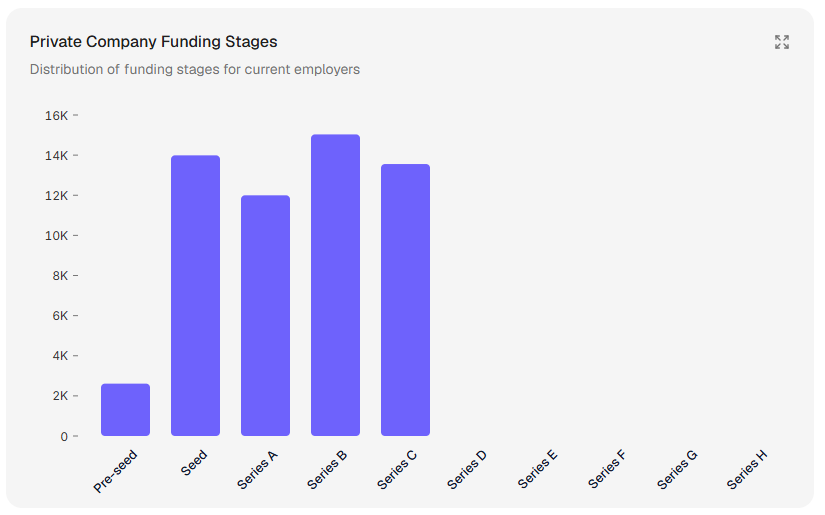
The search intentionally covers companies from Pre-seed through Series C, allowing the report to capture people working across multiple stages of venture-backed company development.
For hiring teams, stage experience can matter considerably. Someone who has operated successfully within a scaling venture-backed organisation may bring experience of changing structures, evolving teams and rapidly developing business requirements that differs from experience gained solely within a mature enterprise.
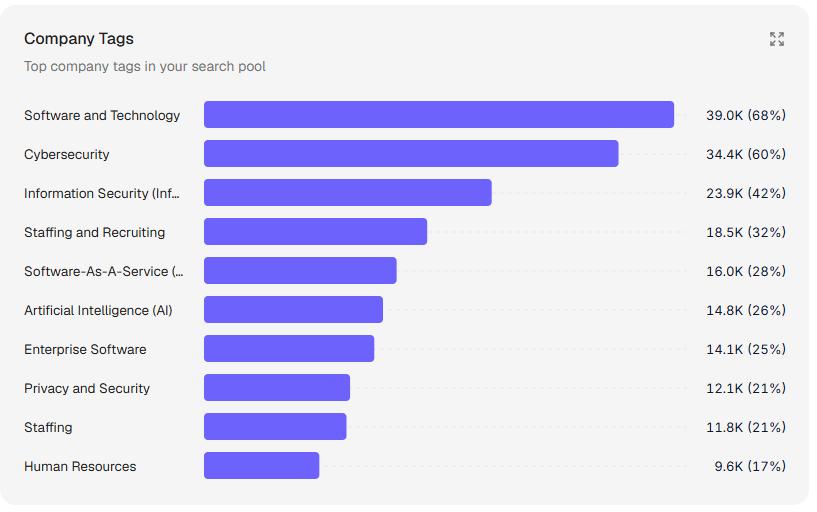
The company tagging strongly reflects the intended technology market: Software and Technology appears against 68% of profiles, Cybersecurity 60%, Information Security 42%, SaaS 28%, Artificial Intelligence 26%, Enterprise Software 25%, and Privacy and Security 21%.
Because company tags can overlap, these percentages should not be added together or interpreted as separate populations. Staffing-related tags also remain visible despite the original exclusions, so the tags are best used to understand the broad ecosystem represented rather than to define the occupation of every individual profile.
Gender Diversity
Gender representation deserves separate consideration because the dataset exposes a substantial difference between the recorded categories while also containing a sizeable population where gender is unknown.
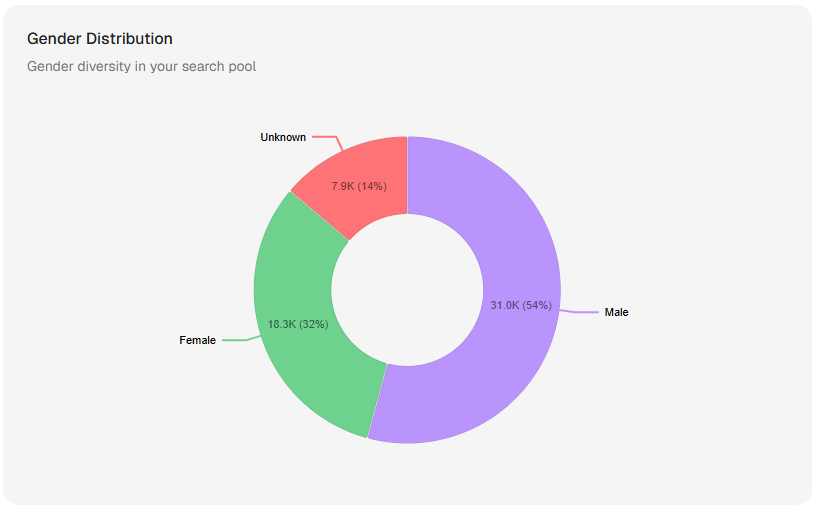
The source records 31.0K profiles as male (54%), 18.3K as female (32%) and 7.9K as unknown (14%).
This indicates a material gender imbalance within the classifications available in the dataset. However, the 14% unknown group is too large to ignore, and the figures should therefore be presented as the recorded gender distribution of this particular search pool rather than as a definitive measurement of gender across the entire US cybersecurity workforce.
Education
Educational backgrounds are varied, with a mix of major US universities, different qualification levels and both technical and commercial fields of study.
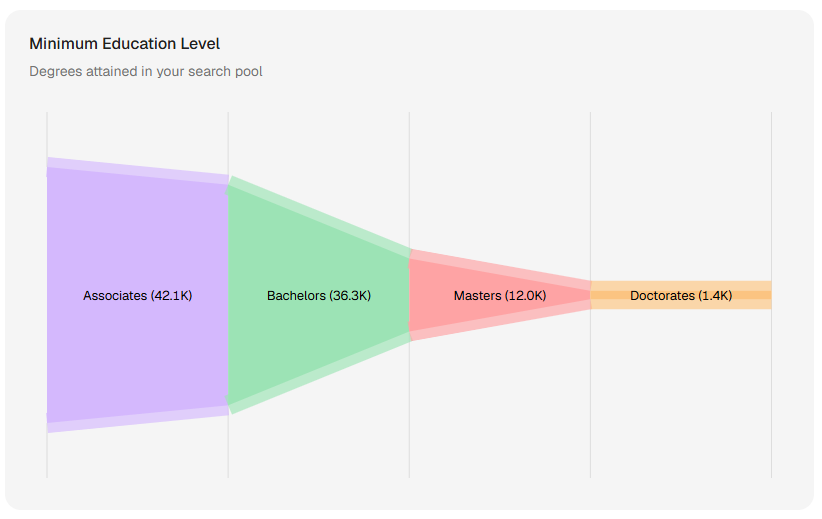
The education data records 42.1K profiles associated with Associate-level attainment, 36.3K with Bachelor’s, 12.0K with Master’s and 1.4K with Doctorates.
These categories should be treated carefully because the counts cannot be read as mutually exclusive percentages of a 57K population. The broader takeaway is that the search pool contains professionals across multiple levels of formal education rather than a single academic pathway.
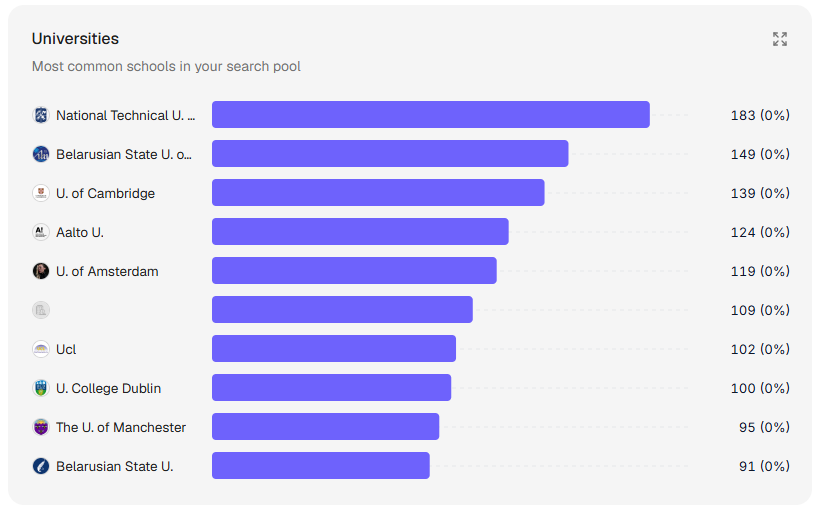
No single university dominates the population. The institutions with the largest numbers shown include University of Texas at Austin, University of California Berkeley, Brigham Young University, Western Governors University, Arizona State University, Stanford University, Georgia Institute of Technology, New York University, Penn State and San José State University. Even the largest represents only around 1% of the search pool.
That dispersion is itself useful. Employers searching for experienced cybersecurity and technology talent would unnecessarily restrict the market by concentrating on a small group of elite institutions.
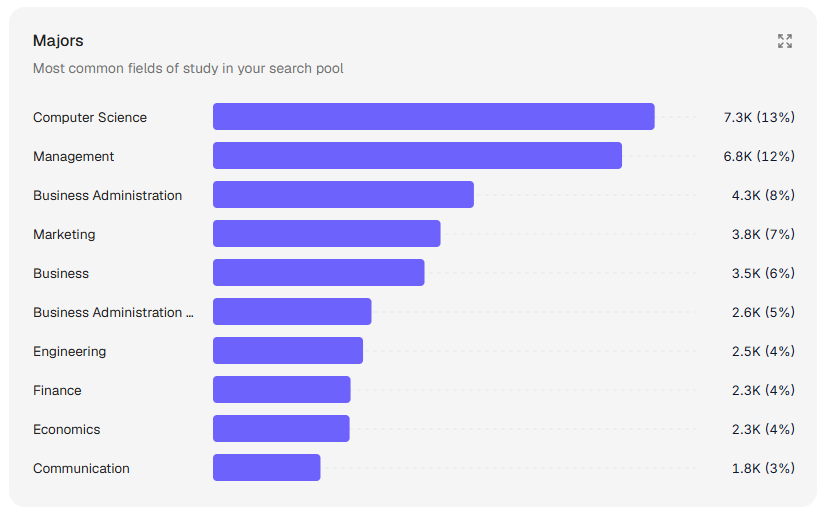
Computer Science is the most common individual field of study shown at 13%, followed closely by Management at 12%. Business Administration, Marketing, Business, Engineering, Finance, Economics and Communication also feature prominently.
The spread between technical and commercial disciplines mirrors the wider workforce profile: VC-backed cybersecurity companies require more than security engineers alone. They also need the management and commercial capability required to build, sell and scale products.
Languages
The language data adds another dimension to the US talent pool, but it needs to be interpreted as languages recorded in profile data, not as a complete test of the languages spoken by every individual.
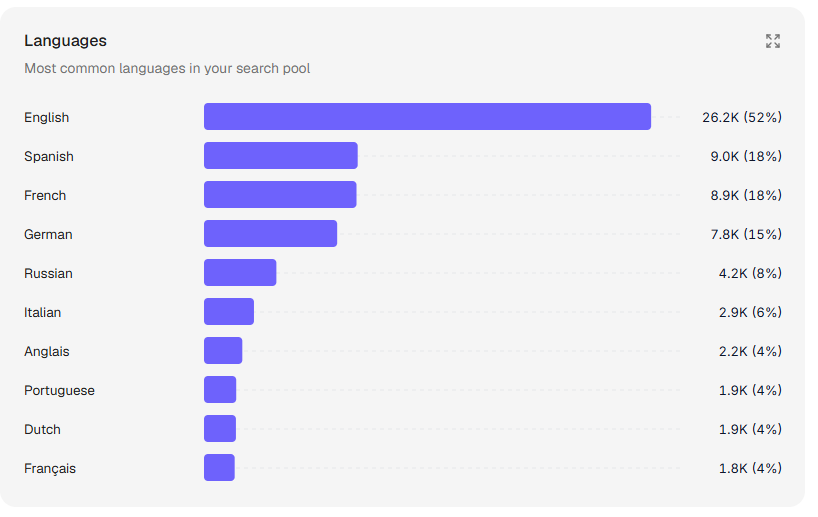
English is the most frequently recorded language at 27%, while Spanish is second at 10%. French accounts for 4%, with Hindi, German and Chinese each represented at around 2%, followed by Russian, Portuguese, Italian and Japanese.
The relatively low recorded percentage for English in a US search pool demonstrates why this data should not be interpreted as language proficiency across the entire workforce. Its greater value is in identifying explicitly recorded multilingual capability, particularly the sizeable Spanish-language population.
Key Insights
The US VC-backed cybersecurity talent market is both experienced and geographically diverse. With an average of 14.7 years of professional experience, this is not predominantly an early-career startup workforce. New York leads the location data ahead of San Francisco, while Austin, Boston, Washington, Los Angeles, Chicago and Denver all offer meaningful alternative talent pools. The hiring opportunity therefore extends well beyond the locations traditionally associated with US venture-backed technology companies.
The data also suggests employers should look beyond direct cybersecurity competitors when building candidate pipelines. Previous employers represented in the talent pool include Cisco, IBM, Microsoft, Oracle, Amazon, Dell Technologies and Google, alongside the US Army and US Air Force. For organisations struggling to find the right people, targeting adjacent enterprise technology and technically intensive environments could significantly broaden the available talent pool.
Cybersecurity businesses also compete for far more than security specialists. Engineering is the largest function at 22%, but Sales and Operations each represent 10%, alongside talent across Support, HR, Marketing and Product. As cybersecurity companies scale, the challenge is therefore not simply finding technical talent but building the commercial, operational and leadership capability required to grow the organisation.
Perhaps the clearest message for employers is that restrictive hiring criteria can unnecessarily narrow an already competitive market. Geographic flexibility, adjacent-industry sourcing and a willingness to consider broader educational and employer backgrounds can substantially expand the addressable talent pool. Rather than starting with ‘Where can we find someone who has done exactly this job for a direct competitor?’, employers may achieve better results by asking ‘Where else can we find the experience and capability needed to succeed in this role?’
Frequently Asked Questions
Where is VC-backed cybersecurity talent concentrated in the US?
New York leads the location data with approximately 3,700 profiles, followed by San Francisco with 3,400 and Austin with 2,400. Boston, Washington, Los Angeles, Chicago and Denver also contain substantial pools
How experienced is US VC-backed cybersecurity talent?
The search pool averages 14.7 years of professional experience, with a median of 13 years.
How long do professionals typically remain with an employer?
Average tenure is 3.8 years, with a median of 2.9 years.
Is San Francisco the largest US cybersecurity talent hub?
Not within this dataset. New York ranks slightly ahead of San Francisco, with 3.7K profiles compared with 3.4K.
Which function has the most talent?
Engineering is the largest functional category at 22%, representing around 12.6K profiles.
What companies have cybersecurity professionals previously worked for?
The leading previous employers displayed include Cisco, IBM, Microsoft, the US Army, Oracle, US Air Force, Amazon, ConnectWise, Dell Technologies and Google.
What is the gender split in the dataset?
The recorded distribution is 54% male, 32% female and 14% unknown. The unknown category makes it important not to treat the first two figures as a complete market-wide gender measurement.
What educational backgrounds are common?
Computer Science is the most frequently shown field of study at 13%, followed by Management at 12%, with Business Administration, Marketing, Engineering, Finance, Economics and Communication also represented.
Is cybersecurity talent only available from cybersecurity companies?
The previous-employer data suggests otherwise. Major technology companies including Cisco, IBM, Microsoft, Oracle, Amazon, Dell Technologies and Google are represented, providing potential adjacent sources of experienced talent.
We develop complimentary no strings attached reports at the job level – share the link to you job and we will do the rest.
Posted in: Blog / Data Analytics | Updated: October 2026


